

HOW TO JULIEENE
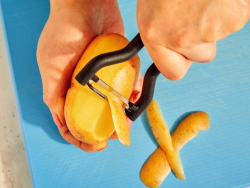 If you’re working with a vegetable that can be peeled (such as a carrot, potato or stalk of celery), you should peel it because you want all of your matchsticks to look the same. Nubbly patches of carrot skin are not welcome. Fun fact, celery can be peeled, and doing so removes a lot of those stringy fibers. If you’re working with a vegetable that can be peeled (such as a carrot, potato or stalk of celery), you should peel it because you want all of your matchsticks to look the same. Nubbly patches of carrot skin are not welcome. Fun fact, celery can be peeled, and doing so removes a lot of those stringy fibers. |
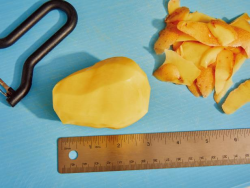 Cut the vegetable into segments the desired length of your julienne. 2 to 3 inches long is a safe bet. Cut the vegetable into segments the desired length of your julienne. 2 to 3 inches long is a safe bet. |
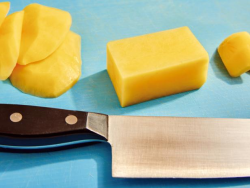 Generally, you’ll want to slice off the rounded sides of whatever you’re cutting to create a rectangle or cube. If you were working in a traditional French restaurant, you’d reserve those scraps for another use instead of putting them into the julienne because they will not turn into perfect matchsticks. But if you’re julienning at home, it’s okay to turn these pieces into julienne as well. Do so by slicing the pieces into thin strips, ideally 1/8-inch thick all around. Generally, you’ll want to slice off the rounded sides of whatever you’re cutting to create a rectangle or cube. If you were working in a traditional French restaurant, you’d reserve those scraps for another use instead of putting them into the julienne because they will not turn into perfect matchsticks. But if you’re julienning at home, it’s okay to turn these pieces into julienne as well. Do so by slicing the pieces into thin strips, ideally 1/8-inch thick all around. |
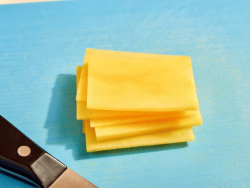 Now that you have a neat square, slice it into planks that are about 1/8 inch thick. Now that you have a neat square, slice it into planks that are about 1/8 inch thick. |
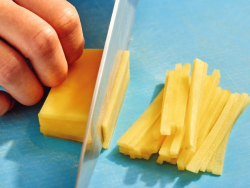 Stack the planks and cut them into 1/8 inch thick strips. Or if it’s easier, work with one plank at a time. Make sure your fingers are tucked away under your hand, away from the blade. Use your knuckles to guide your knife. Walking your fingers backward makes the cut thicker or thinner. Stack the planks and cut them into 1/8 inch thick strips. Or if it’s easier, work with one plank at a time. Make sure your fingers are tucked away under your hand, away from the blade. Use your knuckles to guide your knife. Walking your fingers backward makes the cut thicker or thinner. |